Thursday, November 6, 2014

Choosing appropriate weather for the 'Life After People' environment

I have decided to go with a snowy environment to mimic what would happen in the distant future. Similar to Britain in the Ice Age, it would be devastating for any type of building and natural life. Winter also brings an interesting contrast to the usual depictions of 'life after people' and will allow me to think of some interesting scenarios to present.

I had to begin by texturing the terrain as usual, with the grass and mud layers. Over that, I painted layers of snow and sheet ice. It's important to miss some areas as they really accentuate the snow cover, as seen in the following reference photo.
I will have to work on the sky and time-of-day to give it a darker, more desolate feeling.


Monday, October 13, 2014

Researching Materials

Concrete 

A composite material. Water, some form of aggregate, and Cement make up Concrete. Additives can improve the finish of the material. Some famous landmarks using Concrete include the Hoover Damn, Panama Canal and the Roman Pantheon.

Modern concrete is created as a viscous liquid which makes it easier to pour into complex shapes. Large storage is required for the individual ingredients. Raising water content and adding other ingredients can increase the 'workability' of concrete - the ability to fill a mould/form properly. Since the concrete mixture hardens rapidly, it is important that the production is close to the construction area.

Concrete can 'spall' (flaking) if subjected to freezing and thawing. Too much water in the mix will produce a weaker and less durable concrete. Concrete is resistant to wind and rain, however, trapped moisture rots insulation, sheathing and wood framing of concrete but not the concrete itself. UV Radiation does not harm concrete. As concrete is inedible, it cannot be harmed by insects or animals. Aggressive contaminants (such as those in sewers) do not have much of an effect on concrete, unlike most materials. This is why they are used in industrial drains and sewers. Sulfate attack is possible where the concrete is rapidly wetted and dried.

Concrete has relatively high compressive strength, but significantly lower tensile strength. It needs to be reinforced with materials that are strong in tension. This is why steel bars are used to reinforce concrete walls and pillars.

Glass

Glass is used for windows and certain walkable surfaces of buildings. It is generally made using Soda, Lime and Silica. The ingredients are heated in a furnace to around 1500 degrees Centigrade, and fuse together. Sheets are then formed by a process of drawing, floating and rolling. The glazing quality varies depending on the drawing. 

Glass in buildings is required to resist loads, including wind, impacts from people and animals (including birdstrikes), and sometimes thermal and other stresses. As a general rule, the area of the glass pane dictates the thickness of the pane itself.

Glass is elastic right up to its breaking point, but is extremely brittle, showing no signs of wear prior to failure. Glass performance is dictated by its supporting materials. Thermal movement of glass can be combated by cutting panes with a small allowance around the edges.

Burnt-Clay Brick

These can be made using a variety of methods, ranging from sophisticated factory work to simple labour-intensive technology. Hand-made bricks are usually of lower quality, especially in terms of compressive strength. Longevity of bricks usually varies depending on the quality of ingredients, skills of workers, and the climate where they are used.

Bricks are made using clay, sand, lime, iron oxide, magnesia, and water. Using high amounts of heat, the moulded clay is 'fired' in a kiln and cooled to produce a block shape. The mineral content of the brick informs its colour.

A weakness of using bricks is their weakness against earthquakes. The block structure easily falls apart under the stress of ground movement and causes collapses.


Monday, September 15, 2014

Specular and Bump mapping


Before (with default material applied)


After (with new bump-mapped, specular material)


Process screenshots

Composing the textures in Photoshop


Using Crazybump to generate a Normal/Bump map

Using the Material Editor in CryEngine to create the Concrete bumpmapped material


CryEngine <> 3ds Max <> SketchUp workflow

Importing from SketchUp to Max is quite simple - SketchUp has a built-in exporter for COLLADA, a format that is universally supported by 3D applications. The file even retains the texture and colour information.

Using the CryEngine tools in 3ds Max, I've managed to export a mesh. However, the textures and materials have not been transferred yet.


Saturday, September 6, 2014

EXP1 - Assignment 1 - The Island "Resounder"

The Trailer

Screenshots


Evaluation

Overall, I am pleased with the output of my work. It has a certain unique visual style to it, and some innovative elements. By combining the sublime, the picturesque, along with some of my own personal flair, I've managed to create an environment that tells an interesting story and leaves a lot for the player to explore.

Project Files 

Download file: 1.5 GB 7zip file containing the 'GameSDK' folder
  • Unzip using 7Zip (download from http://7-zip.org/)
  • Paste the 'GameSDK' folder into the CryEngine directory (if clash, delete existing GameSDK folder)
  • Run editor and load the 'Resounder2' level

Monday, September 1, 2014

Concealing the Letter/Number combination

My letter/number combination is H/3, so I'll be incorporating this in the following way, from Macro to Micro: 
  • Shaping the island in a 'H' pattern with 3 distinct island sections.
  • There are 3 alien spheres floating above the island
  • There are 3 mountain peaks on the island.
  • The alien structure will be shaped like a 'H'.
  • A 'H3LP' pattern crudely drawn on the ground in blood. I plan on hiding the 'LP' section and uncovering it at the end. 

Monday, August 25, 2014

Lecture reflections - Weeks 2-4

Real Representation

As a game developer, I'm often forced to consider the balance between performance and visual fidelity when designing virtual environments. As the game has to run in real-time and at a solid frame-rate, it's important to ensure the user experiences it at optimum quality.

As such, the question of art style is vital in informing the performance of the game. Can the artist get by with less-realistic assets if it means the player gets a smooth frame-rate, or is it vital that the environments match real-life. In cases where the art is displaying aspects of real life (e.g. a realistic driving simulator), any obviously-CGI assets will immediately destroy any immersion.

Clay models as environment art in The Swapper
Sometimes the problem can be solved by using innovative techniques to produce art. Facepalm Games' The Swapper [http://theswappergame.com]  uses clay models and other everyday materials to create a realistic - albeit stylised - vision of its environments.

Picturesque

The use of perspectives and giving a sense of scale has always been paramount in ensuring games hold the player's interest. It is not enough to give players an interesting mechanic to mess about with, as it must be tied together with a strong visual direction, both in terms of character and environment art. 

The lake and mountain in this Uncharted: Golden Abyss screenshot aren't modelled, but a Skybox.
Technically, producing art for games is a challenge unlike any other. Artists cannot simply model every element of an environment. Memory and processor limitations requires artists to budget their resources with great emphasis placed on objects near the area of play. Thus, some creative techniques such as Billboarding and Skyboxing are used to provide a sense of scale for the player.

Sublime

The practice of creating wonderment and inducing awe has been one of the focal points of game development, ever since 3D motion graphics were made common. As game budgets rise each year, emphasis is placed on scale and intensity over all else. The recent Call of Duty series has been a prime example of games built to take players on a rollercoaster ride of emotions, with its immense set-pieces, plot points, and James Bond-esque action sequences, all set in a thoroughly unbelievable world of chaos.

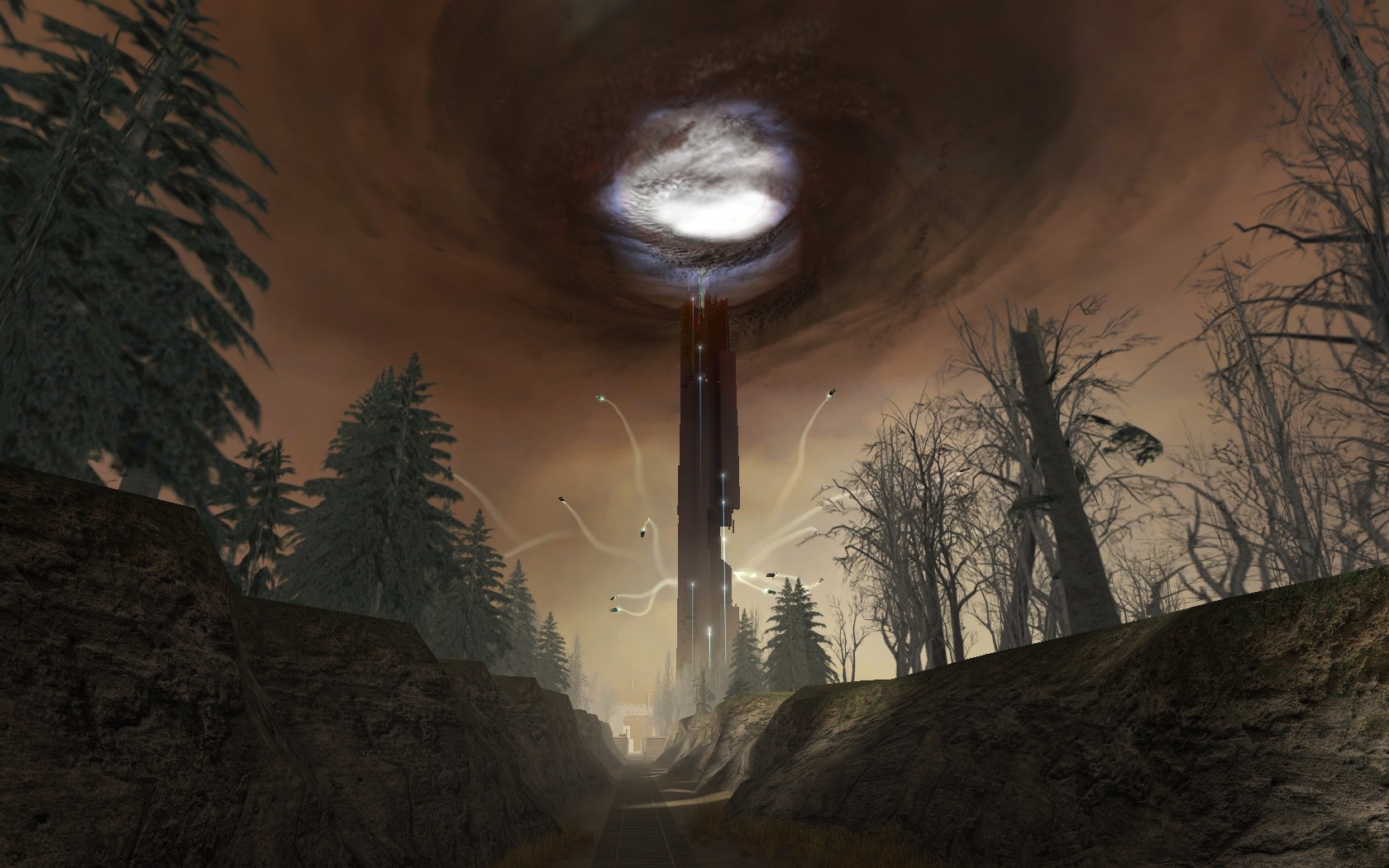
The Citadel building in Half-Life 2
Above all, however, stands the Half-Life series. Half-Life 2, widely regarded as one of the best games of all time, innovated heavily when it released in 2004. Its dystopian atmosphere and unprecendented storytelling, as well as its iconic visual scenery, is a prime example of the power of interactive narrative and worldbuilding.